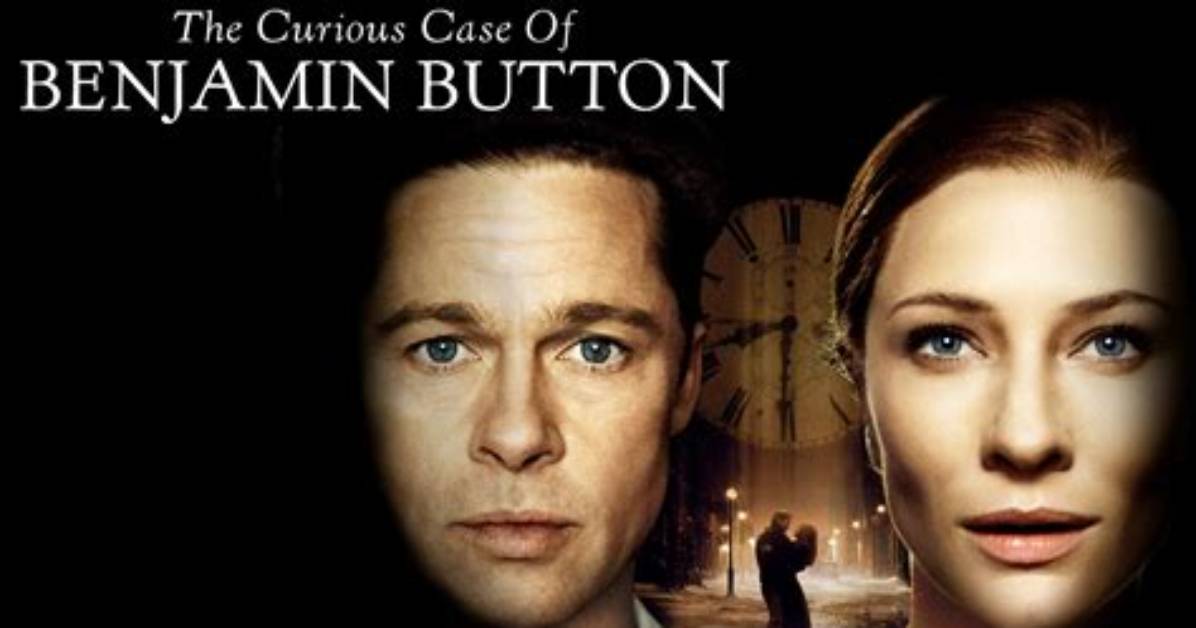
Brad Pitt plays a man who ages backwards in The Curious Case of Benjamin Button. We break down the movie's ending, and what it means.
Brad Pitt plays a man who ages in reverse in David Fincher's 2008 fantasy drama The Curious Case of Benjamin Button, which tells the story of Benjamin's life from the strange circumstances of his birth in 1918, and ends a little time after his death in 2003. Based on the short story of the same name by F. Scott Fitzgerald, The Curious Case of Benjamin Button follows its unusual protagonist on journeys around the world, and the ending montage summarizes what he has learned from a life lived backwards.
Written by Eric Roth and Robin Swicord, The Curious Case of Benjamin Button is only loosely based on Fitzgerald's story, borrowing the central conceit of someone being born an old man and becoming younger over the course of their life, but adding a lot to the story as well. In particular, the movie expands upon Benjamin Button having a great love of his life, Daisy (Cate Blanchett), whom he first meets as a young girl. Over the course of the film, Daisy grows older and Benjamin grows younger until they are finally able to be together when they both appear the same age. However, after Daisy gives birth to a baby daughter Benjamin realizes his condition means he won't be able to be a father to her, and he decides to leave.
The Curious Case of Benjamin Button is told through the framing device of Daisy asking her daughter, Caroline (Julia Ormond) to read Benjamin's diary to her as Daisy lies dying in a hospital bed, with Hurricane Katrina raging outside. By reading the story, Caroline comes to learn the truth about who her father was. The movie ends with Benjamin finally dying as a baby in the flashbacks, and Daisy dying in the present day. So what does the ending reveal about Benjamin, and what does it all mean?
Was Benjamin's Aging Linked To The Clock?
Before the story of Benjamin's life begins, the dying Daisy first tells her daughter a story about a clockmaker called Monsieur Gateau (Elias Koteas), who was commissioned to build a clock for a new train station. M. Gateau was left distraught when his son was killed in the First World War. When the clock was finally unveiled in 1918, the gathered crowd were stunned to see that it was running backwards. Mr. Gateau explained that he designed it that way in the hope that time itself might start turning backwards, and that all the boys who were lost in the war might come home.
There's an obvious link between the story of M. Gateau and the story of Benjamin Button, who is born on the night that the war ends: November 11, 1918. Shortly before Benjamin reaches the end of his life, the backwards-running clock in the train station is replaced with a digital clock that runs normally, meaning that both the clock and Benjamin's lifespans are roughly the same. However, The Curious Case of Benjamin Button exists in the genre of magical realism rather than full fantasy or science fiction, and therefore Benjamin Button's condition and the clock are never explicitly said to be linked to one another. Rather, the clock and Mr. Gateau's wish are instead a metaphor for what Benjamin's life represents: a wish for the return of youth.
Why Benjamin Develops Dementia As He Becomes A Child
Towards the end of The Curious Case of Benjamin Button, Daisy is reunited with Benjamin after a period of several years. Now bearing the appearance of a 12 year-old, he was living on the streets when Child Services picked him up and brought him back to the old people's home, since the address was in his diary. Moody and averse to being touched, Benjamin is apparently developing dementia, and struggles to recognize Daisy when he sees her again. Viewers may be confused as to why Benjamin is development a disease that usually only afflicts old people when he is growing younger every day, but the answer lies in the exact nature of his aging.
It's true that most of the afflictions that come with old age - from arthritis to cataracts - were present in Benjamin when he was born. However, only his body ages backwards, whereas his mind ages forwards. That's why when he was growing up he had a childlike curiosity and naivete, an was mentally the same age as Daisy. Benjamin's particular form of dementia may also be tied to the fact that, as his body turns from an adult into a child, he is mentally deteriorating in the reverse of a normal child's mental growth. In Fitzgerald's story something similar happens; though Benjamin is born fully-grown and talking, in his final years it's said that his memories "had faded like unsubstantial dreams from his mind as though they had never been."

